

From Micro-Manager to Trusted Partner
Early in my management career, I had a boss who was intensely detail-oriented and knew the business like the back of his hand. He scrutinized his staff's activities with precision and dominance, and without realizing it, those behaviors trickled down to me. I thought of myself as an empathetic, people-first manager. I truly believed this. But, it took a lunch with a former employee, a few years after the fact, to learn how my team perceived me. I was told plainly, but kindly, that I had been a micromanager.
Micromanagement rarely comes from malice, but more often from pressure and a lack of coaching. A manager who hovers is usually a manager being scrutinized from above, operating without clear direction, and trying to hold something together in an environment where the definition of success keeps shifting. The behavior is about their fear, not your performance.
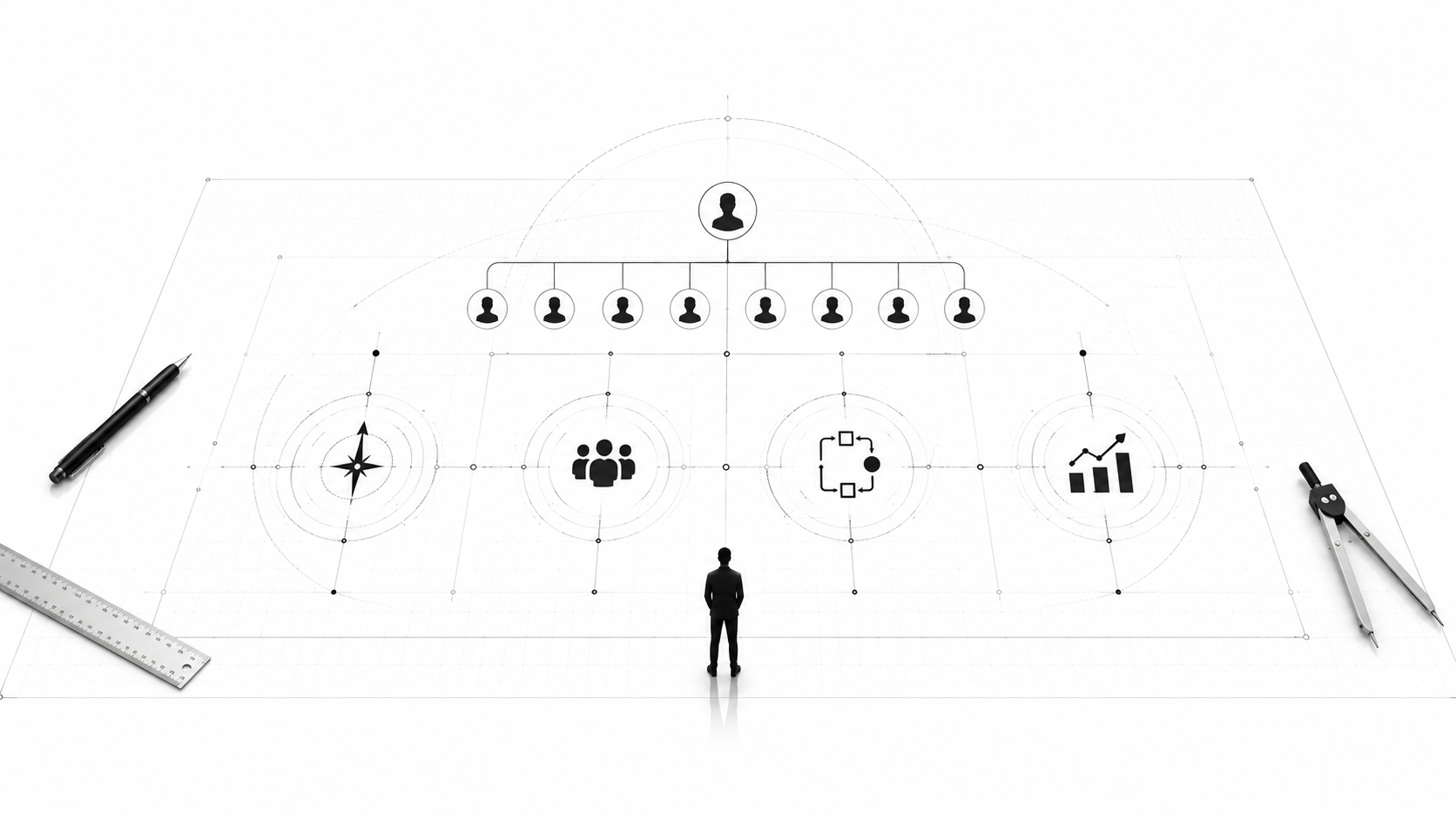
Org Structure as a Design Process
Most leaders think of design as something their team does — to products, to experiences, to systems. Fewer think of their team itself as something to be designed. But the same principles that produce excellent products apply directly to the problem of building an excellent organization: understand the need, define a vision, build deliberately toward it, measure what matters, and communicate the outcome to the people who need to understand it.
This isn't a principle unique to design. The strongest engineering, product, finance, and sales organizations I've observed share the same underlying architecture. What distinguishes them isn't just talent or resources — it's the intentionality of their leaders.
The framework I've used to build design organizations rests on four pillars: Strategy, Culture, Process, and Outcomes.

Leading Without a Title
Some of the most effective leaders I've worked with in my career have been individual contributors. Not because they had informal authority in some abstract sense, but because they understood something specific: leadership is behavior before it is position. You do not need a title to shape a room, move an idea forward, or change how a team approaches a problem.
If you're an individual contributor (IC) who wants to grow into leadership, or who simply wants more impact where you already sit, the question isn't “how do I get promoted?” The better question is: “what would I start doing differently tomorrow?”