

Resumes: A Story About You
Most people treat their resume like a legal document, a record of employment with dates, job titles, and bullet points as proof points. They list their responsibilities and activities with hopes that a hiring manager will effortlessly connect the dots to recognize how amazing they are.
While your resume provides evidence of your work history, it’s not fair to expect the hiring manager to be a detective (unless you’re applying for a job as a detective). Instead, be intentional in communicating a story about you through the progression of your career experience, the measurable value you created, and your potential to achieve more.

From Micro-Manager to Trusted Partner
Early in my management career, I had a boss who was intensely detail-oriented and knew the business like the back of his hand. He scrutinized his staff's activities with precision and dominance, and without realizing it, those behaviors trickled down to me. I thought of myself as an empathetic, people-first manager. I truly believed this. But, it took a lunch with a former employee, a few years after the fact, to learn how my team perceived me. I was told plainly, but kindly, that I had been a micromanager.
Micromanagement rarely comes from malice, but more often from pressure and a lack of coaching. A manager who hovers is usually a manager being scrutinized from above, operating without clear direction, and trying to hold something together in an environment where the definition of success keeps shifting. The behavior is about their fear, not your performance.
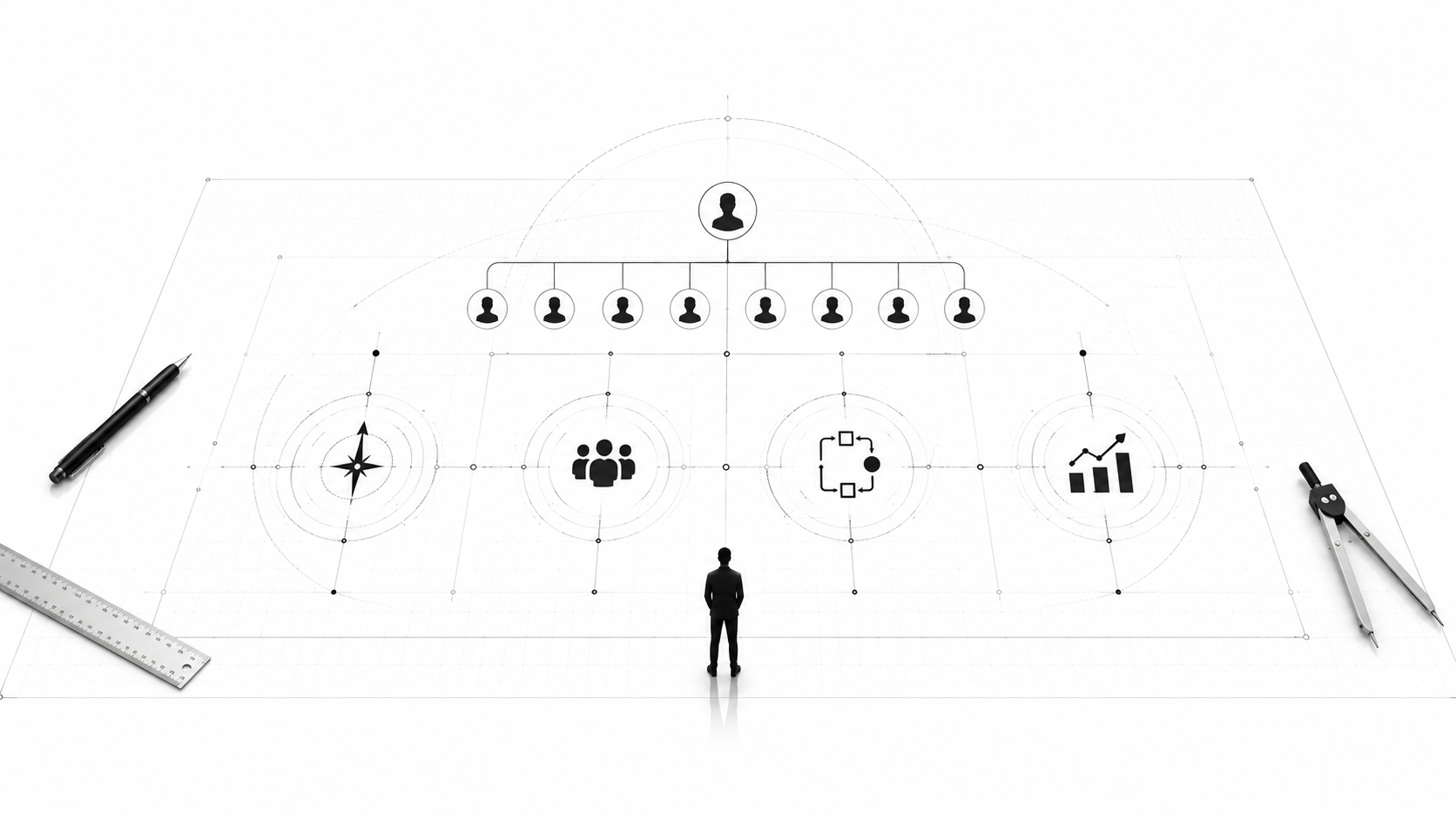
Org Structure as a Design Process
Most leaders think of design as something their team does — to products, to experiences, to systems. Fewer think of their team itself as something to be designed. But the same principles that produce excellent products apply directly to the problem of building an excellent organization: understand the need, define a vision, build deliberately toward it, measure what matters, and communicate the outcome to the people who need to understand it.
This isn't a principle unique to design. The strongest engineering, product, finance, and sales organizations I've observed share the same underlying architecture. What distinguishes them isn't just talent or resources — it's the intentionality of their leaders.
The framework I've used to build design organizations rests on four pillars: Strategy, Culture, Process, and Outcomes.

Navigating a Career Pivot
Career pivots spawn both from internal and external forces. They tend to start with a growing sense that the work you've been doing no longer fits the person you've become, or an environment that you’ve finally grown apart from. By the time most people commit to the pivot, they've already been questioning the status quo for a while.
What I've noticed with professionals in a career transition is that feeling stuck usually comes from trying to identify their new destination before doing the groundwork to figure out their position, then orientation. Where am I going? is almost always the wrong first question. The more useful questions are: who am I now and what value am I actually bringing with me?

3 Tips to Unlock Your Potential
Self-awareness is one of those concepts that sounds simple until you try to practice it. Most people believe they know themselves reasonably well — their strengths, their tendencies, how they come across. In my experience, both as a professional and as a coach, the gap between how we see ourselves and how we actually are is one of the most consistent sources of friction in people's careers and lives.
The good news is that self-awareness isn't a fixed trait. It's a practice, and like any practice, it can be developed deliberately.

Confronting the Mirror
Most of us have a reasonably good internal self-image. We know our intentions are generally good. We know we're not trying to be difficult or dismissive or overbearing. But intentions don't determine impact. What lands with the person across from you is the observable thing — the tone, the timing, the body language, the choice of words, what you prioritize, what you let slide.
Closing the gap between internal experience and external impact is where a lot of professional growth actually lives. It requires feedback, which most people don't receive cleanly because it's hard to give, especially when the people around you have learned how you respond to it. If you've historically gotten defensive, or have deflected, or chose to respond in a way that made the feedback-giver regret offering it — they've stopped.

Empathy as a Business Strategy
One of the clearest lessons from my career is that the empathy that matters most in product work isn't between designers and users — it's within the team that builds the product. UX folks who are deeply connected to end users but disconnected from their engineers, product managers, and stakeholders will rarely ship something great. The collaboration required to build something excellent demands a certain quality of relationship that you can't manufacture. People of different roles can't afford to act like consultants to each other. They need to actually trust one another.
A team that has that quality — where people genuinely care about each other and about the shared outcome — produces better work. Not marginally better. Dramatically better. This is the kind of care you see in a high-performing sports team, where trust is built through sustained shared effort, stress, and discomfort. Where people know they can depend on each other when it counts — in real-time on the playing field when the stakes are the highest. Take that mindset from the field to the office and see how well it works.

Leading Without a Title
Some of the most effective leaders I've worked with in my career have been individual contributors. Not because they had informal authority in some abstract sense, but because they understood something specific: leadership is behavior before it is position. You do not need a title to shape a room, move an idea forward, or change how a team approaches a problem.
If you're an individual contributor (IC) who wants to grow into leadership, or who simply wants more impact where you already sit, the question isn't “how do I get promoted?” The better question is: “what would I start doing differently tomorrow?”